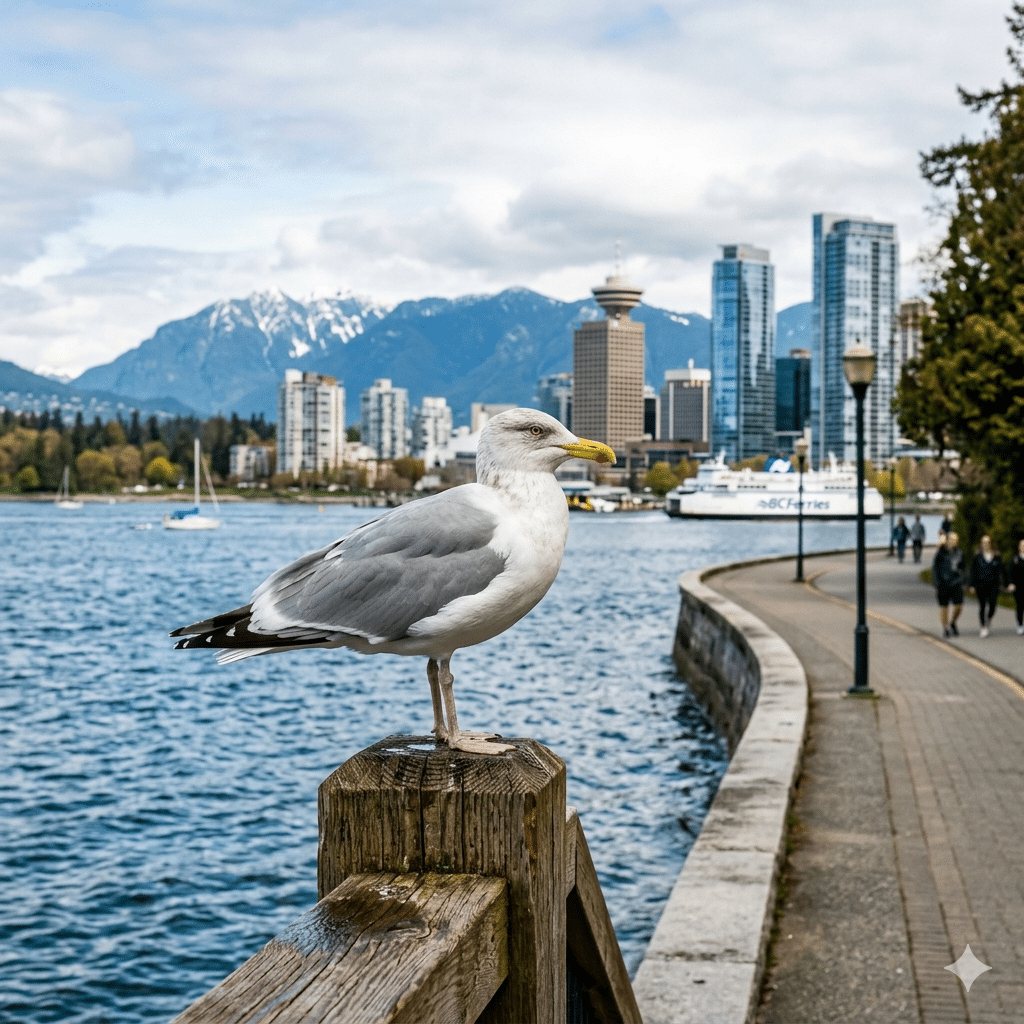
The Vancouver Seawall is an engineering marvel, a twenty-eight-kilometer loop of stone and concrete designed to keep the Pacific Ocean at bay while providing a scenic playground for the city’s human residents. However, for the coastal birds of the Burrard Inlet and English Bay, this structure represents a massive, permanent disruption of the natural intertidal zone. In nature, a shoreline is a soft, sloping transition of mudflats, eelgrass, and tide pools. The Seawall replaced this with a “hard” shoreline—a vertical barrier that effectively deleted the traditional transition zone.
Yet, if you spend an afternoon walking the path from Coal Harbour around to False Creek, you’ll notice that the birds haven’t left. Instead, they have engaged in a fascinating display of behavioral plasticity, recalibrating their ancient instincts to thrive in a landscape of masonry, tourists, and bike lanes.
The Mechanics of the Vertical Hunt
One of the most striking adaptations is the shift from horizontal to vertical foraging. In a natural environment, a bird like the Northwestern Crow or the Black Oystercatcher waits for the tide to recede, exposing a wide plane of treats. Along the Seawall, that plane is gone. In its place, the birds have learned to exploit the vertical crevices of the stone blocks.
The crows of Vancouver have become particularly famous for their cognitive flexibility. They have turned the Seawall into a hunting tool. You will frequently see them prying mollusks or crabs from the lower stones at low tide, then flying precisely above the paved pedestrian path. They use the hard, predictable surface of the Seawall as a nutcracker, dropping their prey from a calculated height to shatter the shell against the asphalt. This isn’t just luck; it is a learned behavior passed down through generations of urban birds who have realized that concrete is more efficient than sand for opening a meal.
Architecture as an Analog for Nature
For species that traditionally rely on the rugged cliffs of the British Columbia coast, the modern urban shoreline offers a surprising number of “natural” analogs. The Pelagic Cormorant, for instance, is built to nest on sheer rock faces where land-based predators cannot reach. To a cormorant, the underside of the Burrard Street Bridge or the steep, concrete embankments near Stanley Park look remarkably like a cliffside in the Gulf Islands.
These birds have successfully colonized the city’s infrastructure, using man-made ledges to raise their young. By doing so, they have actually managed to find a safer environment than some natural ones, as the verticality of the Seawall combined with the high volume of human traffic acts as a deterrent to natural predators like raccoons or mink, who are less willing to brave the crowds to reach a nest.
The Human Element: Tolerance and Timing
Perhaps the most significant adaptation along the Vancouver Seawall isn’t physical, but psychological. Coastal birds have had to radically alter their “flight initiation distance”—the technical term for how close a threat can get before a bird takes flight. A Great Blue Heron in a remote northern inlet might fly away if a human gets within fifty meters. On the Seawall, that same species will stand perfectly still on a rock just three meters from a whizzing cyclist.
This habituation is a vital survival strategy. If these birds flew away every time a person walked by on the Seawall, they would spend so much energy on “false alarms” that they would eventually starve. They have developed a sophisticated ability to distinguish between “passive” humans (the joggers and commuters who ignore them) and “active” threats.
Furthermore, the birds have synced their lives to the city’s pulse. Gulls and crows have become expert observers of human behavior, congregating near specific benches or concessions near Second Beach exactly when the lunch crowds arrive. They have effectively mapped the Seawall not just as a geographical location, but as a schedule of caloric opportunities.
The Cognitive Cost of the City
While these adaptations are a testament to avian intelligence, they aren’t without a cost. The modern shoreline presents “sensory traps.” The artificial light from the Seawall’s lamps can interfere with the internal clocks of migratory species, sometimes prompting them to forage deep into the night when they should be resting. Similarly, the acoustic environment of a city—the constant hum of the Lions Gate Bridge and the floatplanes overhead—forces birds to change the frequency and timing of their songs to ensure they can still communicate and find mates.
The Vancouver Seawall is more than a scenic walk; it is a living laboratory of evolution in real-time. It proves that nature is not a static thing that exists only in “wild” places. It is a flexible, resilient force that finds a way to turn a concrete barrier into a home, proving that even in a world of stone and steel, the wild finds its footing.
I am the founder and owner of Fauna Facts. My mission is to write valuable and entertaining information about animals and pets for my audience. I hope you enjoy the site!